
See what changed, what matters now, and what to do next.
Reporting brings together company context, task progress, connected sources, and evidence so users can understand the business without stitching updates together manually.
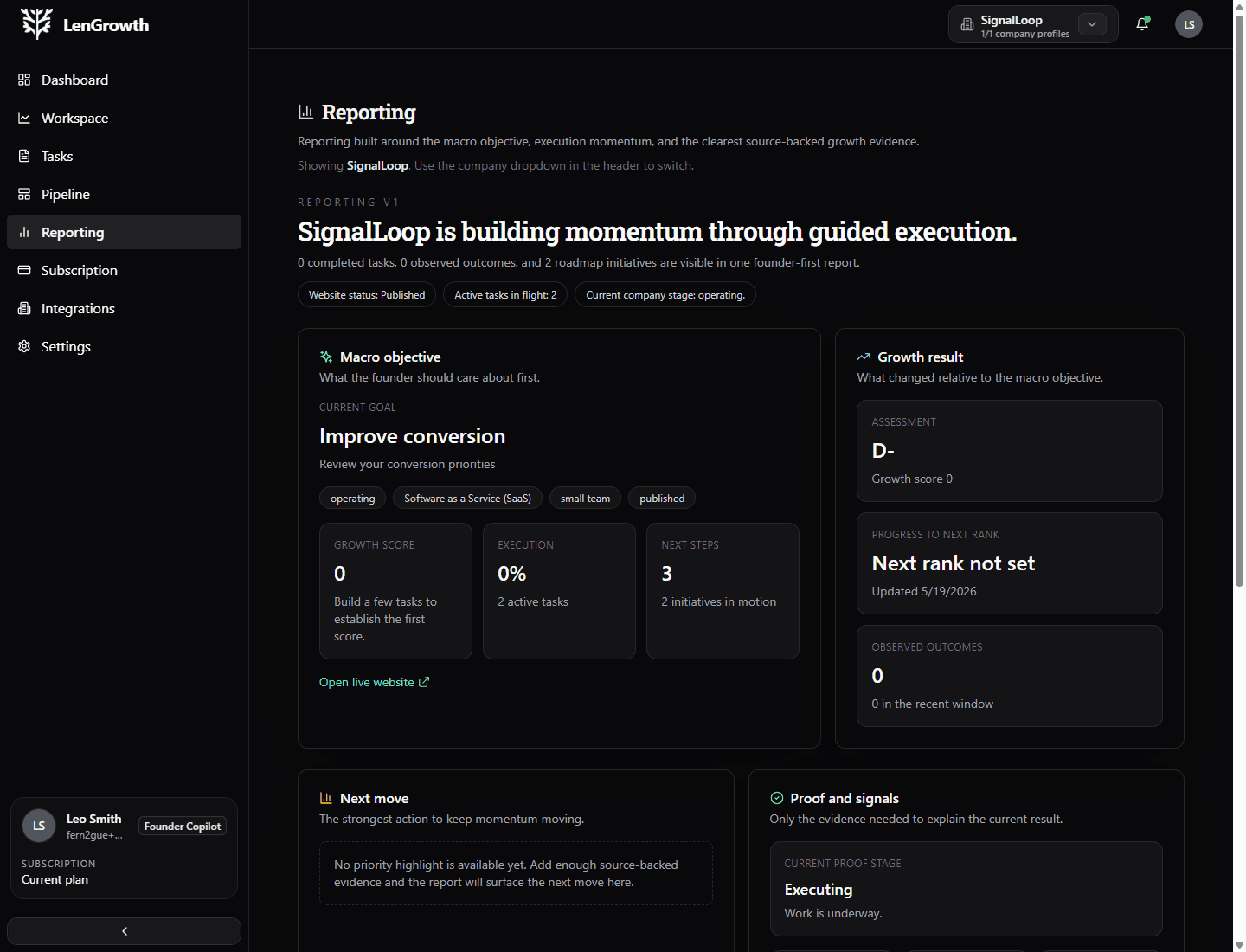
Reporting loop
The report explains the current state in one view.
It stays tied to the objective, the signals, and the next move.
Reporting with a point of view
The report should help the user decide what to do next.
LenGrowth reporting is less about decorative charts and more about explaining movement: where the business stands, what changed, and what action deserves attention.
Where are we now?
Read the current state without piecing together multiple tools.
What changed?
Spot the shift that matters before it gets lost in a busy week.
What matters most?
Keep the report tied to the current objective instead of a vanity metric.
What should happen next?
Let the view point directly to the next decision or action.
What reporting answers
A report built for action, not just observation.
The best report is the one that makes the next step obvious and gives you enough evidence to trust it.
Product deep dive
The report stays connected to the objective and the evidence.
The user can read the current state, see the supporting evidence, and understand the next recommended action.
Macro objective
The report stays tied to the current business goal.
Execution momentum
See whether work is active, completed, or stalled.
Proof and signals
Understand which evidence supports the current view.
Connected sources
Bring in analytics and channel data when available.
Founder headline
A single line that frames the current business state.
Growth score
A quick signal to help prioritize attention.
Next move
The report should point directly toward action.
The report stays tied to the objective.
It explains the next move.
It can use connected source data when available.
From signal to decision
Turn evidence into the next move.
The report stays connected to current objectives and execution history so it can explain why a recommendation matters.
01
Frame the objective
Keep the report anchored to the current business goal.
02
Read momentum
See whether work is active, completed, stalled, or waiting on input.
03
Check the evidence
Understand which signals support the current view and which are missing.
04
Choose the next move
Translate the report into a practical decision or task.
What users feel
The next move stays visible.
The platform connects context, work, support mode, and proof so the user is not guessing what just happened or what needs attention next.
The report stays tied to the objective.
It explains the next move.
It can use connected source data when available.
Why clients like this model
A report that points to action, not just observation.
LenGrowth does not stop at charts. It explains the current state, ties it back to execution, and highlights the next move with the evidence behind it.
A few things stay constant
The work stays connected to a real objective and is easier to follow from start to finish.
AI helps where it is useful, not where it creates risk.
Specialist support can join without losing the original context.
A few questions clients usually ask.
The best report is the one that helps you decide what to do next.
When the report stays tied to evidence and action, it becomes part of the operating rhythm instead of a separate artifact.